
What is Biochar?
Biochar is a carbonaceous material obtained from biomass through thermochemical processes such as pyrolysis or hydrothermal carbonisation (HTC). It resembles charcoal but is produced to enhance its stability and applicability in soil improvement, carbon storage, and energy use. Its porous structure and high stability make it an excellent carbon sink and an efficient solid fuel.
Biochar has a vast potential
According to a study by the Imperial College on sustainable biomass availability in the EU and UK, the biomass usable for bioenergy in 2030 is estimated to be between 520 and 860 million dry tonnes (Imperial College London Consultants, 2022). Assuming a conservative 20% conversion rate from biomass to biochar, the total potential production in 2030 lies between 104 and 172 million tons of biochar. Biochar has two primary applications:
- Carbon Sink: Biochar can act as a powerful carbon capture vehicle when used for soil improvement, as a cementitious material substituting cement, or as a replacement for bitumen in asphalt production. Each ton of biochar used in these applications can store approximately 2.7 tons of CO2 (Biochar foundation, 2021). . ased on these estimates, biochar’s carbon sequestration potential in 2030 would range between 280 and 464 million tons of CO2, representing 7% to 12% of 2023 EU and UK CO2 emissions (3,750 million tons CO2 equivalent) (Department for Energy Security & Net Zero, 2025).and (Eurostat, 2025)
- Carbon-Free Energy Source: Biochar is also an excellent energy carrier. Raw biomass is a heterogeneous, relatively low-energy-density material, making transportation and direct use inefficient. However, transforming biomass into biochar creates a homogeneous, high-energy-density material comparable to mineral coal. With each kilogram of biochar containing approximately 6,000 kcal, its total energy potential in Europe is estimated to be between 798 TWh and 1,319 TWh, equivalent to 19% to 31% of Europe’s (EU+UK) annual natural gas consumption for 2023 (4,234 TWh) (Eurostat, 2025) and (Department for Energy Security and Net Zero, 2025) .
… and it is highly cost-competitive
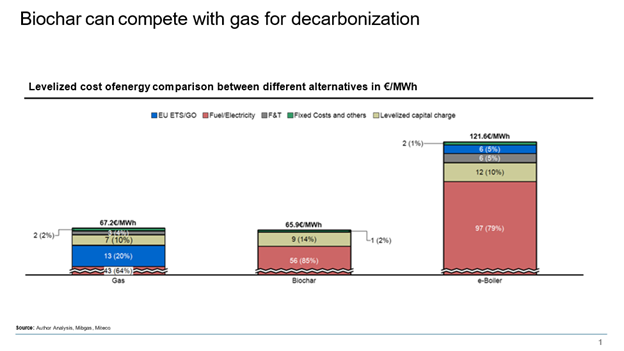
From an economic perspective, biochar is one of the most competitive solutions for replacing fossil fuels in medium-temperature and high-temperature industrial processes (in which heat pumps are not an alternative).
Assuming that biochar’s price for energy is equivalent to its best alternative use—carbon storage—we can estimate its value. If carbon capture certificates are priced at 140€/ton (Puro Earth, 2025) and considering a carbon capture rate of 2.7 tons CO2 per ton of biochar plus a 50€ value as a soil improver, a potential price for biochar could be around 428€/ton. At this price, the levelized cost of heat production from biochar is slightly more competitive than natural gas and significantly more competitive than electric boilers (See chart):
But Scaling Biochar Requires Addressing Key Challenges.
Despite its immense potential, biochar has been systematically overlooked in government plans. Its widespread adoption will require a coordinated effort from policymakers, biomass owners, industry players, and technology providers.
Several key challenges must be addressed to scale up biochar production and use it effectively:
- Supply Chain & Logistics: Biomass collection, transportation, and processing need efficient infrastructure to ensure cost-effectiveness.
- Market Development & Standardization: A professionalized biomass and biochar market is essential to enable stable pricing, consistent quality, and secure demand.
- Regulatory Framework & Incentives: To stimulate biochar adoption, governments must provide clear policies, incentives, and carbon credit mechanisms.
While biochar presents a transformational opportunity for decarbonization, unlocking its full potential will depend on tackling these scalability barriers. Addressing these challenges in a structured manner will ensure that biochar becomes a mainstream tool in Europe’s energy transition.
A future article will further explore how biochar compares with other decarbonization technologies.
References
Biochar foundation, n. f. (2021). Life Cycle Assessment of biochar produced from waste wood in the furnace Kon-Tiki. Zarámí : Charles University Environment Centre . Retrieved from chrome-extension://efaidnbmnnnibpcajpcglclefindmkaj/https://www.biochar.foundation/wp-content/uploads/2021/03/Life-Cycle-Assessment-of-biochar_-CO2-removal-calculation.docx.pdf
Department for Energy Security & Net Zero. (2025, 02 27). 2023 UK greenhouse gas emissions, provisional figures. Retrieved from chrome-extension://efaidnbmnnnibpcajpcglclefindmkaj/https://assets.publishing.service.gov.uk/media/6604460f91a320001a82b0fd/uk-greenhouse-gas-emissions-provisional-figures-statistical-release-2023.pdf
Department for Energy Security and Net Zero. (2025, February 27). Digest of United Kingdom Energy Statistics (DUKES) 2024 – Chapter 4: Natural Gas. UK Government. Retrieved from Digest of United Kingdom Energy Statistics (DUKES)
Eurostat. (2025, 02 27). Natural gas supply statistics. Retrieved from EuroStat: https://ec.europa.eu/eurostat/statistics-explained/index.php?title=Natural_gas_supply_statistics
Eurostat. (2025, 02 27). Statistics Explained. Retrieved from Eurostat: https://ec.europa.eu/eurostat/statistics-explained/index.php?title=Quarterly_greenhouse_gas_emissions_in_the_EU
Imperial College London Consultants. (2022, January). Sustainable biomass availability in the EU, to 2050. Concawe Review Volume 30 • Number 2 •.
Puro Earth. (2025, 02 27). CORC Carbon Removal Indexes. Retrieved from Puro Earth: https://puro.earth/corc-carbon-removal-indexes